
What is actually going on
Airlines restrict snub-nosed breeds because these dogs breathe less efficiently than others, and heat and stress make that worse. The restrictions are real and they exist for a reason.
But they are applied by breed name, not by dog. Two English Bulldogs of the same age can be in completely different shape, and a rule written around a breed cannot tell them apart.
A BOAS fit to fly assessment looks at the individual animal instead of the label on its pedigree. A dog that passes may support an airline’s individual assessment on routes that would otherwise be closed, and the airline still decides.
What we will and will not do
We will tell you honestly what an assessment result means for the route, and find the route and the carrier that fit.
We will not put a dog on an aircraft that should not be on one. If the assessment says no, we say no, and then we talk about ground options or about waiting for a better season.
Five documented cases
Max, English Bulldog, Madrid to Panama.
Passed his BOAS fit to fly assessment and travelled from Madrid to Panama without trouble.
Luna, English Bulldog, to Miami.
Extra care, meticulous planning, and a mother waiting at the other end.
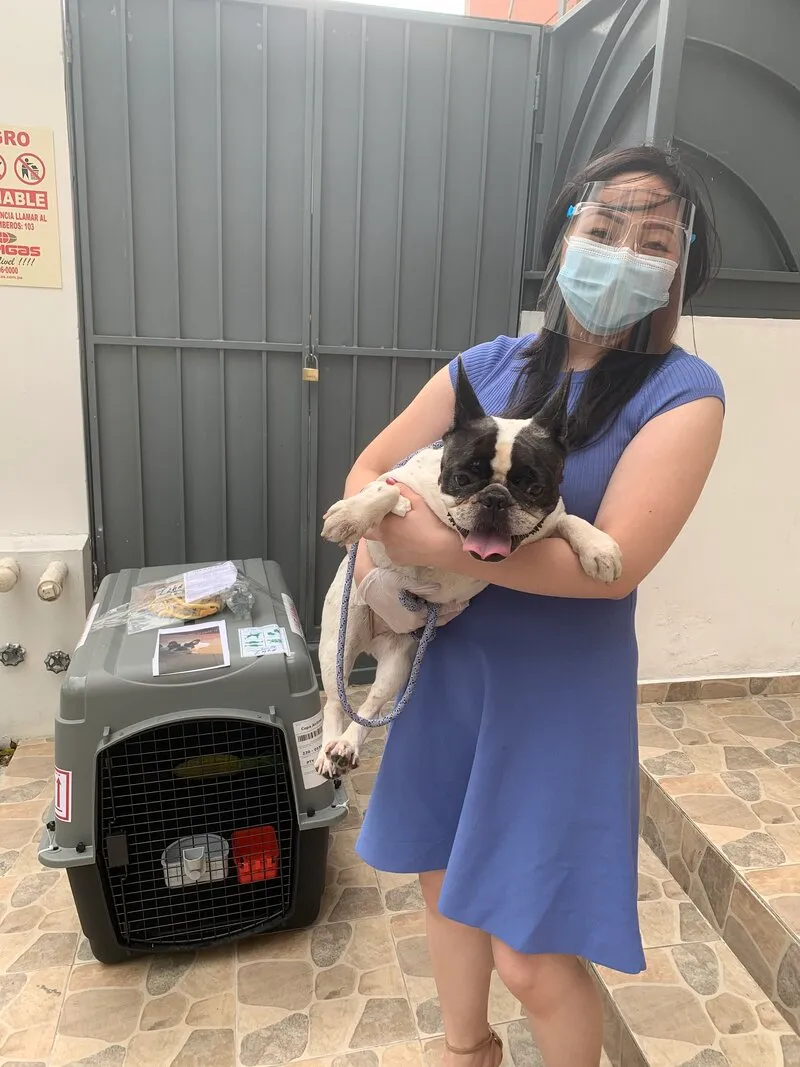
Monik and Roku, French Bulldogs, Panama to Toronto.
Already booked when Copa decided to stop carrying the breed. After heavy persuading the airline let them travel. They were the last two French Bulldogs Copa flew out of Panama.
Penny, French Bulldog, Panama to Manila.
In cabin with her owners, all documents prepared by us.
Lucy and Stevie, Antigua Guatemala to Washington DC.
Their family tried to arrange it themselves and hit a wall, because Lucy is a Boxer. That is when they called us.
And one that nearly went wrong for the opposite reason. Kareem had been recorded by his previous vet as an English Bulldog. He was not one. The record was confirmed and corrected before he travelled.
What changes for these dogs in practice
A larger crate. Snub-nosed breeds require 10% larger container than the standard calculation for their measurements.
A different position in the hold. Snub-nosed dogs must be stowed as far away as practical from other loads to ensure they have the largest amount of air space available in the hold.
IATA Live Animals Regulations, Container Requirement 1, Edition 52, January 2026.
Route and season matter more. Temperature limits for these breeds are tighter, and connections are chosen to keep ground time short.
Airline policy moves. Copa stopped carrying French Bulldogs in the middle of one of our bookings. Which carrier accepts which breed is checked at the time of booking, every time, never from a list written last year.
Tell us the breed and where you are going
Breed, age, weight, destination, and what any airline has already told you. We will tell you whether an assessment is worth doing before you spend anything on one.