What you get
We collect your animal from your home. In Panama, and in most US states through our partners.
We prepare the documents. The health certificate with an accredited veterinarian, the Panamanian consulate stamp, and the arrival notice filed with the Panamanian health authority.
We choose the route. Sometimes that is not the right flight. We arrange the connecting flights so your animal arrives where it needs to be. When one crate was too large to fly to Washington, we flew the dog to Miami and his family drove the last leg. When no direct flight to Panama would take a crate that size, five animals left Mexico with PetAir México to Bogotá and continued with Luann Pets, and we took over in Panama.
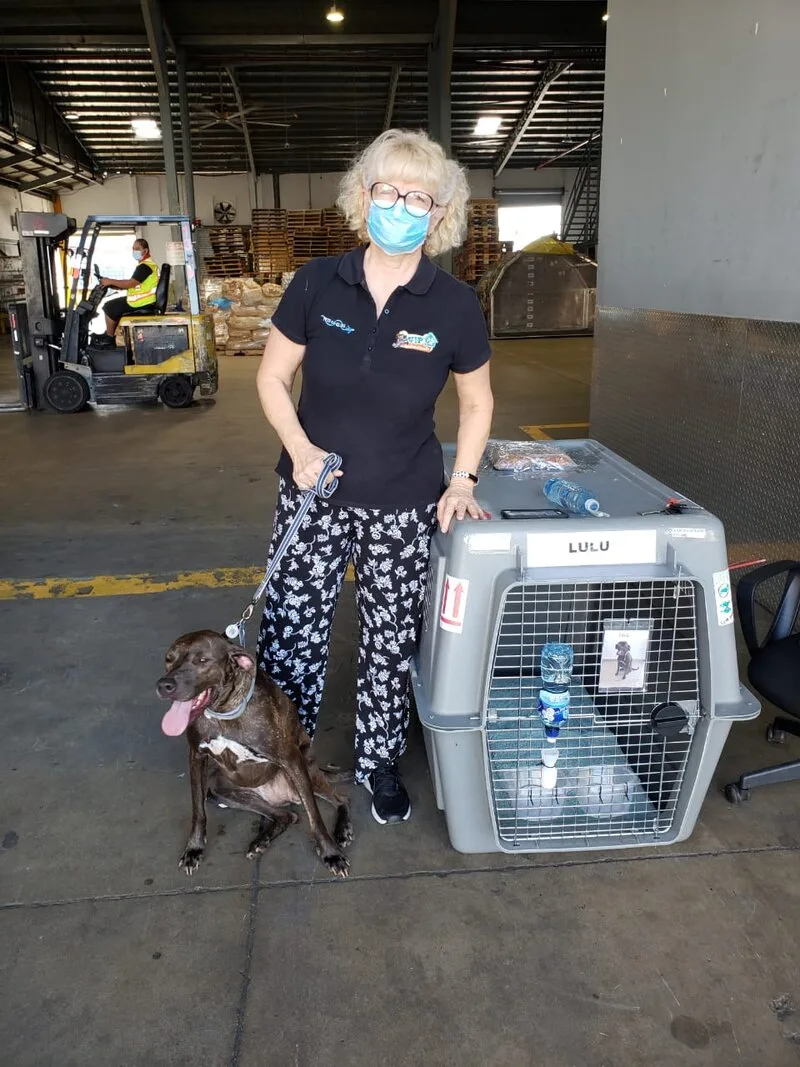
We supply and check the crate. Airline compliant, measured to your animal, custom built when nothing off the shelf fits.
We can board before and after the flight. Our own kennels, one for dogs and one for cats. Not a third party.
You get photos and messages while your animal travels.
The estimate is free, and it comes in writing
Our service estimate depends on the route, documents, clearance, transport and crate. Government inspection and quarantine fees may be charged separately per animal. That is why no single number can be published honestly.
The form asks four questions to start, then the rest. It takes a few minutes and it means you explain your situation once instead of across a dozen messages.
Most people are nervous about the hold. Here is what it is actually like.
The animal hold is pressurised, temperature controlled, ventilated and has ambient lighting. Conditions vary by aircraft, airport and carrier, and the space is handled according to the applicable airline and transport requirements. A correctly sized crate holds the animal securely and leaves room to stand up, turn around and lie down.
An animal in the cabin spends the flight under a seat, at ear level with the trolley, the announcements and everyone else's luggage.
In the cabin the limit is one cat per passenger and three cats per flight, so three cats need three passengers. The airline must confirm the exact limit.
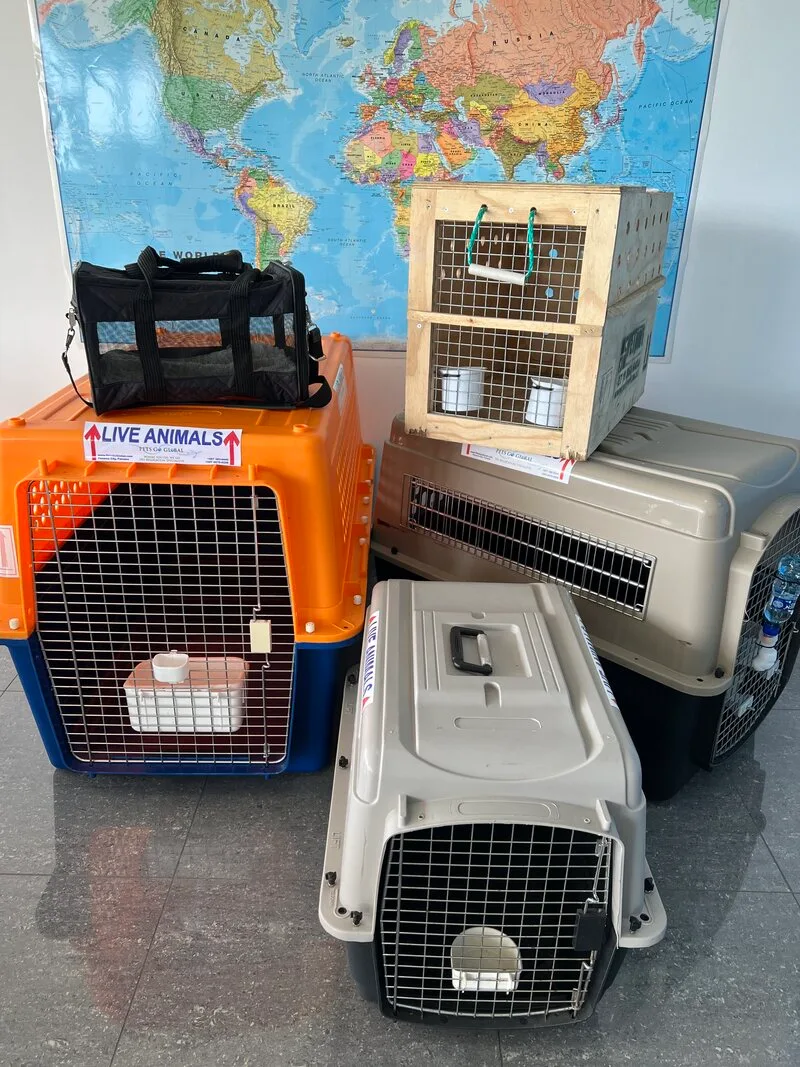
Cooper flew to Miami with his family. His siblings Cash and Nora were small enough for the cabin. Cooper was not, so he flew cargo. Same aircraft, same day, all three collected together on arrival.
We do not fly tranquillized animals. If a tranquillized animal behaves oddly on the way, nobody can tell whether the drug is causing it or something else is, and that is the one moment when somebody has to know. Most commonly used tranquillizing drugs lower the blood pressure, which also occurs naturally at high altitudes. The air pressure of an aircraft in flight is set at the equivalent of approximately 8,000 ft, and the combination of altitude and drugs is potentially fatal in the old, chronically sick or stressed animals. Calming by darkening the container and putting it in a quiet place when not in the aircraft will calm most animals, and any medication decision must be made with the treating veterinarian.
IATA Live Animals Regulations, Container Requirement 1, Edition 52, January 2026.
What Panama actually requires
For travel from the United States to Panama. Other countries of origin are checked individually.
Rabies, and a wait. Vaccinated from three months of age, and at least thirty days must have passed since the first rabies vaccination. Animals under four months of age cannot enter Panama at all.
More than rabies. Dogs also need distemper, parvovirus, leptospirosis and hepatitis. Cats also need panleukopenia, rhinotracheitis and calicivirus. Each recorded with the date, the manufacturer and the lot number.
Parasite treatment before departure, internal and external, recorded on the certificate.
A certificate with two signatures and a stamp. Stamped by a Panamanian consulate. It must also be apostilled. Valid for thirty days from issue.
Home quarantine must be requested. The owner must submit the Home Quarantine Request at least three days before arrival, with the certificate, flight number and arrival time attached.
When plans change mid-journey
A vet wrote the wrong breed.
Kareem's previous veterinarian recorded him as an English Bulldog. He was not one. Confirmed, corrected, and he travelled from South Carolina through Florida to Panama.
An airline changed its policy mid-booking.
Monik and Roku were already booked when Copa stopped carrying French Bulldogs. After a good deal of persuading, the airline let them travel to Toronto. They were the last two French Bulldogs Copa flew out of Panama.
An earthquake closed the destination.
Twelve young Malinois were in the air from Amsterdam to Venezuela when the airspace shut. Their flight was diverted to Panama and they were left in a warehouse with no food and no way to continue. We got special permission and took all twelve into VIP Vacation Kennels. Copa allowed two dogs a day to Maracaibo, and after not quite two weeks every one of them was home.
We do not promise that nothing goes wrong. We promise somebody is on it when it does.
Why us
IPATA member
Our own boarding facilities in Panama, so before and after the flight your animal stays with us rather than with a stranger
Based at Costa Sur Plaza in Panama City, not an agent in another country
Tammy had three cats moved from Alaska to Panama. They arrived in excellent condition and she was updated several times during the trip.
Facebook review.
Catherine moved from Boquete to Philadelphia. Her cats were boarded ten days at our cat facility while the medical paperwork was done, she was sent videos and photos daily, and a driver was arranged from New York for the last leg.
Google review.
Questions we get asked
Tell us where you are going
Four questions to start, the detail on the next screen, and a written figure back.
Something that does not fit the form, or a question first? English on 6678-0220, Spanish on 6747-2424.